
Historical Markers Tour
Original Owner: D.H. Abernathy
406 Quitman Street
Built: 1896
David Harper Abernathy was born in 1858 in Arkansas. He moved with his family to Pittsburg in 1864. After learning business in Nashville, Tennessee, David returned to help run his father's dry goods store. He was a major leader in town and was heavily involved in the Methodist church. This house was built for the Abernathy family in 1896 by George Barber. It is a two-story Queen Anne-style home, with a wraparound porch, spindle work and a front gable. The original front door is intact and much of the interior has remained unchanged. The house was expanded and modified after World war II. The house is a reminder of a century of the influential Abernathy family.
Recorded Texas Historic Landmark - 2015
Bolton Cemetery FM 993 Pittsburg, Texas 75686
Ebenezer (Ebb) and Martha Bolton settled in this area in the 1850s. They established an extensive plantation and owned a number of slaves before the Civil War. Following Ebb Bolton's death in 1877, his widow made arrangements to provide land to their former slaves. This cemetery, which began in 1861 upon the death of Martha Bolton's mother, Rebecca Durley, became a part of the Bolton community, a Freedmen's town which built up in the area. Both Ebb and Martha Bolton are interred here, as are many of the former slaves and their descendants.
Ebenezer Cemetery was officially established when Israel B. Rape deeded property for the cemetery in 1857. However, Rape and his wife Sarah are buried in Pittsburg's Rosehill Cemetery. Ebenezer Community was founded by the Rapes and several other pioneering families who arrived in the area from Georgia during the 1850's. The older known burial in the cemetery is the of infant Pair Clementine Bailey, who died in September 1870. A cemetery association was organized in 1971 to preserve and maintain the site. The cemetery has been enlarged throughout Donations of property and now contains two acres. Today Ebenezer Cemetery remains active and serves as a reminder of the early Camp County Settlement.
Old Center Point School
Center Point began as a Freedmen’s community about 1865-70. The Willie Johnson family were the first settlers and were soon joined by other families. In 1899, G.W. Goulsby opened a one-room school, the first in the settlement; Pete Griffin was the first teacher. In 1916, a new five-room school was built. In later years, campus additions, partly funded by the Julius Rosenwald Fund, included a teacherage, library, dormitories, cafeteria, and gymnasium. Students maintained a farm and garden and operated a cannery. Center Point School was closed in 1952. (1996)
The Texas Legislature created Camp County from the northern part of Upshur County in 1874, and voters chose Pittsburg as their county seat. The county built its first courthouse in 1881. As Pittsburg grew, the two-story brick edifice became too small for the county’s needs, and in 1928, commissioners hired the Paris, Texas architectural firm of Smith and Praeger to design a new house of justice. Contractors Wentzel and Wood received the contract for the construction, which was completed in December 1928. The Classical Revival courthouse features a stepped parapet, flat arched windows, and Corinthian columns. Today, the courthouse remains a central part of life in Camp County. Recorded Texas Historic Landmark - 2004.
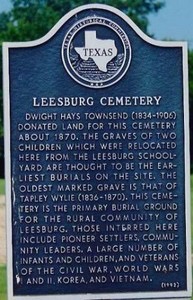
Stop in to visit the historical marker and gravesite of local legend Carroll Shelby at the Leesburg Cemetery. Note: Please be mindful and respectful of all.
First United Methodist Church in Pittsburg, Texas was organized in 1857 by Rev. J.W. Harvey Hamill and the Pitts family, for whom the town was named.The original congregation worshipped in a log structure, then shared a 2-story frame building with the Masonic Lodge before erecting a larger frame sanctuary in 1888-89. The current brick and prairie style church was designed by James Edward Flanders and was built in 1903-1905 and dedicated on April 2, 1905.
The stunning stain glass windows created in St. Louis are original to the building as well as the Barckhoff pipe organ and the handcrafted church pews and choir chairs.
The church was recorded as a Texas Historic Landmark in 1976.
Note: The church is not open to tours and walkins. But you can admire the historic stained glass and architecture from the outside.
St. Beulah C.M.E. Church
The C.M.E. Church in Pittsburg was organized by the Rev. Joseph Lloyd, who came here between 1870 and 1889. The name St. Beulah was adopted after this sanctuary was constructed in 1896. The wood frame Gothic revival building has an asymmetrical facade with two towers of differing sizes. The stained-glass lancet windows were donated by various members of the congregation. Recorded Texas Historic Landmark - 1985.
The now current Northeast Texas Rural Heritage Museum is the site of the famous Shoot Out at Pittsburg Depot.
A domestic dispute involving George “Dallas” Smart, wife Annie, and U.S. Army Lt. John W. Heard resulted in a public confrontation here on Feb. 10, 1885, as Heard planned to leave town. In the ensuing struggle, fueled by a crowd, Heard shot and killed Dallas Smart. The next day, Heard appeared before County Judge M. N. Brooks, who determined it was self-defense and ordered him released. A question of legal authority caused the state attorney general to rule the trial proper, given the judge’s role as magistrate. Heard later defended himself in a court martial and a subsequent trial on the incident and went on to a distinguished military career. Annie Smart died in the New Mexico Territory in 1900. (2005)